शाफ्ट के लिए कौन सी फोर्जिंग विधि सर्वोत्तम है?
Choosing the best forging method for a shaft depends on more than the required diameter or overall length. Material grade, shaft geometry, production volume, dimensional tolerances, mechanical loading, tooling cost, and subsequent machining all influence the most suitable process. For industrial applications, शाफ्ट फोर्जिंग is often selected when the component requires reliable mechanical performance and controlled grain flow, but the specific forging route still needs to match the shaft's design and production requirements. The three main forging approaches used for shaft production are open-die forging, closed-die forging, and roll forging. Each process has a different balance of flexibility, production efficiency, tooling investment, dimensional control, and suitability for particular shaft geometries. There is therefore no single forging method that is best for every shaft. Open-die forging is generally well suited to large or low-volume shafts, closed-die forging is often more economical for repeat production of relatively standardized geometries, and roll forging can be advantageous for long shafts and components with a predominantly uniform cross-section. The right choice comes from matching the forging process to the actual operating and manufacturing requirements.
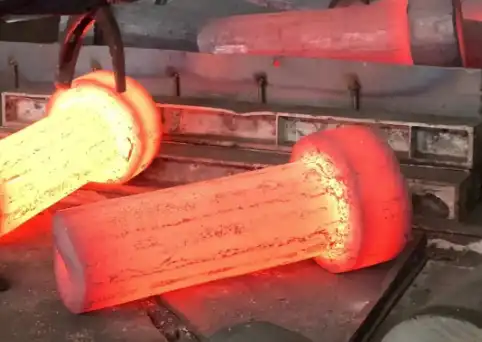
Which forging processes are commonly used for shaft manufacturing?
Open-die forging for large and customized shafts
Large shafts can be produced via open-die forging in one of the most versatile ways. The hot workpiece is squeezed between dies that do not fully surround the material. Therefore, the metal might flow in different directions while the forging is taking place.
This versatility makes open-die forging particularly useful for large-diameter shafts, heavy forgings, prototypes, replacement parts, and relatively low-volume production. It also applies in cases where the finished part is of a size so that special closed dies would be difficult or uneconomic.
The main advantage is the ability to adjust the reduction and shape of the workpiece at different stages of forging. Depending on the equipment and forging sequence, the cross-section can be developed by a combination of processes such as upsetting, drawing out, and radial reduction.
However, open-die forging generally requires more machining than a good closed-die technique. Dimensional tolerances and surface quality might also be highly dependent on the forging equipment, operator control, die condition, and subsequent machining operations.
Open-die forging is often possible for very large shafts when the importance of reducing machining allowance is less critical than flexibility and material integrity.
Closed-die forging for repeatable shaft production
Closed die forging, also known as impression die forging, uses dies that contain the desired component geometry. The heated billet is placed in the die cavity and deformed in a controlled manner until the material fills the desired shape.
The equipment can offer predictable dimensions from one part to the next, making this approach particularly attractive for medium- to high-volume production. Closed-die forging can further reduce machining needs and material waste relative to manufacturing the entire shape from a bigger stock material where the shape of the shaft is suitable for the method.
Another benefit is consistency of process. With the right development of the tooling and forging procedure, producers can duplicate the same fundamental geometry throughout huge production runs.
But tooling is a big consideration. Designing and producing customized dies needs an initial expenditure, and that investment may not be justified for a small order. Likewise, closed-die forging is not attractive for a very large shaft, a highly customized shaft, or a shaft that is frequently changed in design.
For standardized shafts produced in large quantities, closed-die forging might thus be a good compromise between production rate, reproducibility, and material utilization.
Roll forging for long and relatively uniform shafts
Roll forging is a process that uses spinning dies to gradually reduce and shape a heated workpiece. The entire component is not produced in a single enclosed chamber. Instead, the material is rolled through and reduced in a controlled sequence.
This method may be effective for lengthy components and shafts where the geometry is relatively constant along its length. One of the main advantages is that it allows a good longitudinal material flow and a high cross-section reduction.
Roll forging can also reduce the quantity of material that would otherwise have to be machined away. This can enhance material utilization and reduce downstream machining time for suitable geometries and production quantities.
The method is not equally well suited to all shaft designs. Other forging routes may be more appropriate for very irregular geometries, particularly big sections or components with considerable localized changes of cross-section.
Thus, the optimal application for roll forging is usually a shaft or shaft-like part for which the shape, material, and desired production rate are amenable to progressive deformation between spinning dies.
What should engineers consider when selecting a shaft forging method?
Match the forging process to the shaft material.
One of the first things to consider is the selection of material. The different alloys react differently to heating and plastic deformation.
Common shaft materials include carbon steels, alloy steels, stainless steels, and other technical alloys. Every material has its own range of forging temperatures, its own way of deforming, its own response to heat treatment, and its own sensitivity to things like overheating or rapid cooling.
For example, an alloy steel shaft designed for heavy mechanical loads might require a precisely controlled forging and heat treatment sequence. The forging method should not be decided independently of the material specification since the deformation history may influence the final microstructure and mechanical qualities.
Engineers should therefore verify that a शाफ्ट फोर्जिंग provider has experience with the necessary material grade and can regulate the relevant heating, forging, cooling, and heat-treatment phases.
Consider shaft size, geometry, and forging weight.
The feasibility of a particular forging method is highly dependent on the physical parameters of the shaft.
Open-die forging is typically used for big-diameter or heavy shafts because of the substantial flexibility of the process and the lack of requirement for a large dedicated impression die. Smaller and more standardized shafts can be closed-die forged, providing the manufacturing numbers warrant the cost in tooling.
The shaft geometry is quite significant also. A basic cylindrical shaft is easier to forge than a part having several transitions in diameters, flanges, shoulders, grooves, or other localized features.
Straightness and handling in forging have to be considered for long shafts as well. For such components the forging sequence and the equipment capability have to be taken into account, instead of selecting a method only because it is theoretically capable of generating the desired cross-section.
Evaluate production volume and tooling cost.
The volume of production may affect the economics of the forging process.
If only a small quantity of custom shafts are needed, open-die forging might be chosen to minimize the high initial tooling cost of dedicated closed dies. If only a few parts are required, the unit price may be higher, but the whole project cost may be lower.
But for high-volume production the opposite can be true. The cost of the initial investment in closed-die tooling can be spread over many more parts. Shorter cycle times, predictable geometry, and less machining can all help make the process cheaper over the entire production run.
Roll forging also is advantageous if large quantities of a suitable length and somewhat uniform shaft geometry need to be manufactured.
Therefore, a useful cost comparison should include more than the stated forging price. Engineers should keep in mind:
- tooling and die expense
- consumption of raw materials
- Cycle Time of Forging
- मशीनिंग सहनशीलता
- मशीनिंग समय।
- heat treatment expenses
- निरीक्षण आवश्यकताओं
- shred and rework
- estimated annual production volume
The lowest forging quotation is not always the lowest total manufacturing cost.
Define the required mechanical performance.
Shafts are subjected to combinations of torsion, bending, axial loading, impact, vibration, and cyclic fatigue. These loading conditions need to be taken into account in the choice of forging procedure.
A forging can assist in producing a flow of material that conforms to the general shape of the component. However, the final performance of a forged shaft does not depend just on the forging operation. Properties can be influenced by material chemistry, amount of reduction, temperature of forging, heat treatment, grain structure, quality of machining, and condition of the surface.
Fatigue performance is especially critical for shafts that are susceptible to cyclic loads. Stress concentrations can occur at acute shoulders, keyways, grooves, threads, and sudden variations in diameter. These design elements should be considered in conjunction with the forging and machining process.
In addition, the manufacturer may be required to execute or document mechanical testing and nondestructive examination of the शाफ्ट फोर्जिंग in accordance with the appropriate specification for critical applications.
Account for dimensional tolerances and machining.
Forging is not automatically a substitute for machining.
The forging process generally produces a near-final shape with a controlled machining allowance, while final machining is used to achieve the required dimensions, surface finish, concentricity, bearing fits, keyways, threads, or other precision features.
If a shaft requires tight dimensional tolerances, engineers should determine which dimensions can realistically be achieved during forging and which will need machining.
This distinction is important when comparing different suppliers. A forging that appears cheaper at the initial stage may require considerably more machining if it is supplied with larger allowances or less consistent dimensions.
The best manufacturing route should therefore be evaluated on the basis of the finished shaft, not only the forged blank.
How does the forging method influence shaft quality?
Grain flow and microstructure
One of the important reasons manufacturers use forging for shafts is the ability to develop controlled material flow during deformation.
The direction and continuity of grain flow can influence how a forged component responds to mechanical loading. For shafts, this can be especially relevant because the component may experience repeated bending and torsional forces during service.
Roll forging can produce a pronounced longitudinal flow pattern in suitable shaft geometries. Open-die forging can also develop beneficial deformation and material flow when the forging sequence is properly designed. Closed-die forging provides controlled deformation within the die cavity and can produce consistent geometry and microstructure when the process is correctly established.
However, grain flow should not be treated as a guarantee of superior performance. Final properties depend on the complete manufacturing route, including material selection, deformation, heat treatment, cooling, machining, and inspection.
Strength, toughness, and fatigue resistance
The mechanical properties of a forged shaft are determined by more than the forging method.
A properly controlled process can help eliminate or reduce certain internal discontinuities associated with the starting material and can produce a refined and appropriately oriented microstructure. Heat treatment may then be used to achieve the required combination of strength, hardness, and toughness.
For example, a shaft requiring high strength may use a controlled alloy steel and a specified quench-and-temper treatment. A different application may place greater emphasis on toughness or fatigue resistance.
For this reason, the forging process, material specification, and heat-treatment procedure should be considered as one manufacturing system rather than as separate decisions.
Surface condition and dimensional consistency
Surface condition is another area where the three forging processes can differ.
Open-die forging may leave a surface that requires substantial machining, especially when the shaft has large allowances or undergoes multiple deformation operations. Closed-die forging can provide a more defined external profile, although flash, die marks, scale, and other surface conditions may still require subsequent operations.
Roll forging can provide efficient dimensional reduction for suitable continuous profiles, but final shaft dimensions and surface requirements still need to be established based on the customer's drawing.
In most industrial applications, critical shaft surfaces such as bearing seats, sealing areas, and threaded sections will require machining or other finishing operations regardless of the selected forging method.
Which forging method is best for different shaft applications?
Open-die forging for large, heavy, or low-volume shafts
Choose open-die forging for शाफ्ट फोर्जिंग when flexibility is more important than high-volume tooling efficiency. Typical situations include:
- बड़े व्यास वाले शाफ्ट
- heavy industrial shafts
- कस्टम-इंजीनियरिंग घटकों
- कम मात्रा वाले ऑर्डर
- prototypes and development parts
components requiring substantial dimensional changes during forging
Its main advantage is adaptability. Its main trade-off is that additional machining may be required, and production efficiency may be lower than a dedicated closed-die process for high-volume standardized parts.
Closed-die forging for high-volume standardized shafts
Closed-die forging is often a strong candidate when the shaft has a repeatable geometry and production volume is high enough to justify dedicated tooling.
यह निम्नलिखित सुविधाएं प्रदान कर सकता है:
- repeatable component geometry
- efficient production cycles
- reduced machining allowance for suitable designs
- good material utilization
- consistent production across large batches
The main limitation is tooling investment. If the design changes frequently or the production quantity is very small, the economics may not be favorable.
Roll forging for long, straight, and continuous profiles
Roll forging is worth considering when the shaft is relatively long and its cross-section changes progressively rather than abruptly.
It can provide efficient material reduction and favorable longitudinal material flow while reducing machining requirements for suitable components.
However, the process should be evaluated against the shaft drawing, not selected simply because the component is cylindrical. Shoulders, flanges, diameter transitions, and other geometric features can affect process suitability.
How should buyers compare shaft forging suppliers?
The forging method is only one part of supplier selection. Two manufacturers may use the same basic process but produce different results because of differences in equipment, process control, inspection, heat treatment, and machining capability.
Before placing an order, buyers should provide the supplier with as much engineering information as possible, including the shaft drawing, material grade, dimensions, required quantity, tolerances, heat-treatment requirements, surface requirements, and inspection specifications.
It is also useful to ask whether the supplier can provide:
- सामग्री प्रमाण पत्र
- forging process documentation
- ऊष्मा-उपचार अभिलेख
- आयामी निरीक्षण रिपोर्ट
- mechanical test results when required
- nondestructive testing reports for critical components
- ट्रेसेबिलिटी दस्तावेज़ीकरण
- मशीनिंग क्षमता
- sample or prototype parts before full production
For critical shafts, supplier capability should be evaluated from the raw material through forging, heat treatment, machining, inspection, and final delivery rather than focusing only on the forging stage.
निष्कर्ष
The best forging method for a shaft depends on the component's size, geometry, material, production volume, mechanical requirements, tolerances, and total manufacturing cost. There is no universal process that is ideal for every shaft.
Open-die forging is generally a practical choice for large, heavy, customized, or low-volume shafts because it offers considerable process flexibility. Closed-die forging is often more suitable for repeat production when consistent geometry and production efficiency justify the tooling investment. Roll forging can be advantageous for long shafts and relatively uniform profiles where progressive deformation and longitudinal material flow are beneficial.
एक सफल के लिए शाफ्ट फोर्जिंग project, engineers should evaluate the complete manufacturing route rather than selecting a forging method in isolation. The most suitable solution may combine forging with controlled heat treatment, machining, and inspection to achieve the required final performance. When comparing suppliers, buyers should assess not only the forging equipment but also material control, process capability, quality documentation, machining capacity, and inspection procedures. This approach provides a more reliable basis for selecting a shaft manufacturing process that balances performance, consistency, lead time, and total cost.
आपका कस्टम मेटल पार्ट्स पार्टनर: ISO-प्रमाणित और विश्व स्तर पर विश्वसनीय
Shaanxi Welong Int'l Supply Chain Mgt Co., Ltd., established in 2001, is a leading provider of customized metal parts for various industries. With ISO 9001:2015 and API-7-1 certifications, we offer comprehensive capabilities in forging, casting, and machining. Our expertise spans a wide range of materials and processes, ensuring high-quality products tailored to your specific needs. Our experienced team assists in optimizing production processes, quality control, and timely delivery worldwide. With a track record of serving over 100 customers across 20+ countries, we strive to lead in international supply chain management and advance China's intelligent manufacturing. Choose Welong for innovative solutions, competitive pricing, and exceptional service in metal part production. Contact us at info@welongpost.com यह जानने के लिए कि हम आपकी परियोजना की सफलता में किस प्रकार योगदान दे सकते हैं।
सामान्य प्रश्न
1: What is the main difference between open die and closed die forging for shafts?
Open die forging offers more flexibility for large or custom shafts, while closed die forging provides better dimensional accuracy and is more suitable for high-volume production of standardized designs.
2: Which forging method is best for producing long, slender shafts?
Roll forging is particularly well-suited for producing long, slender shafts with uniform cross-sections, offering excellent grain flow orientation and high production rates.
3: How does the choice of forging method affect the mechanical properties of a shaft?
Different forging methods can result in varying grain structures, orientations, and overall mechanical properties. For example, roll forging typically produces shafts with superior fatigue resistance due to favorable grain flow.
4: Is open die forging cost-effective for small production runs of shafts?
Yes, open die forging can be more cost-effective for small production runs or custom shafts due to lower tooling costs and greater flexibility compared to other methods.
संदर्भ
1. स्मिथ, जे.डी., और जॉनसन, आर.ए. (2018)। उच्च-प्रदर्शन शाफ्ट के लिए उन्नत फोर्जिंग तकनीकें। जर्नल ऑफ मैटेरियल्स प्रोसेसिंग टेक्नोलॉजी, 256, 112-124।
2. ब्राउन, ई.टी., एट अल. (2019)। ऑटोमोटिव शाफ्ट के लिए ओपन डाई और क्लोज्ड डाई फोर्जिंग का तुलनात्मक विश्लेषण। इंटरनेशनल जर्नल ऑफ मैकेनिकल इंजीनियरिंग, 42(3), 298-310।
3. वांग, एल., और झांग, एच. (2020). एयरोस्पेस-ग्रेड मिश्र धातु शाफ्ट के लिए रोल फोर्जिंग मापदंडों का अनुकूलन. सामग्री विज्ञान और इंजीनियरिंग: ए, 775, 138922.
4. थॉम्पसन, एस.के. (2017). फोर्ज्ड शाफ्ट में सूक्ष्म संरचनात्मक विकास: एक व्यापक समीक्षा. प्रोग्रेस इन मैटेरियल्स साइंस, 89, 31-91.
5. एंडरसन, एमआर, और डेविस, सीएल (2021)। औद्योगिक शाफ्ट उत्पादन के लिए फोर्जिंग विधियों का लागत-लाभ विश्लेषण। जर्नल ऑफ मैन्युफैक्चरिंग प्रोसेसेस, 62, 213-225।
6. ली, जेएच, एट अल. (2016). उच्च-शक्ति वाले स्टील शाफ्ट के थकान प्रदर्शन पर फोर्जिंग तकनीकों का प्रभाव. इंजीनियरिंग सामग्री और संरचनाओं का थकान और फ्रैक्चर, 39(8), 969-982.

Share your inquiry, get the quotation accordingly!

चीन वेलॉन्ग- धातु समाधान में आपका विश्वसनीय भागीदार

